My newsletter is named after a traditional Jewish blessing upon encountering the majesty of a large body of water: “Blessed are you, our eternal G-d, Ruler of the Universe, who made the great sea.” BTS is a free, monthly publication which shares Jewish and non-Jewish approaches to mindful, contemplative living. Some come from from spiritual teachings from the past and the present; others from my Zen practice and Jewish faith. Included here are also some of my own news as well. BTS is a conversation, and I enjoy hearing from and responding to the readers.
· Seek traditional knowledge.
· Respect the sacred nature of the self.
· Have reverence and care of speech.
· Be a careful listener.
· Be appreciative and thankful.
· Show positive feelings toward others.
· Have a balanced perspective and mind.
— From “Hózhoojík’ehgo Nanitin” (“The Blessing Way Teachings”), Navajo Nation Office of Education
Welcome to the 50th issue of Blessing the Sea, my dear friends!
I recently went on a Road Scholar trip to the Navajo reservation in Arizona, which left me with many educational and spiritual experiences. In this notebook, rather than present them in a linear account, I have decided to organize them along the daily cycle of The Four Directions of the Diné (Navajo), quoted below from the Explore Navajo Museum in Tuba City, AZ. This cycle, central to the Navajo beliefs, unites time, direction, and intention.
I. East. This is the direction of the early dawn, and it is our thinking direction because we must think before we do anything. The Creator answers our prayers in the early morning. We ask for [the holy] guidance and assistance to help us with whatever we do.
We are walking the rim of the Canyon de Chelly in the early morning as the Sun is just beginning to intensify the delicate gradations of green and red against the pale-blue sky.
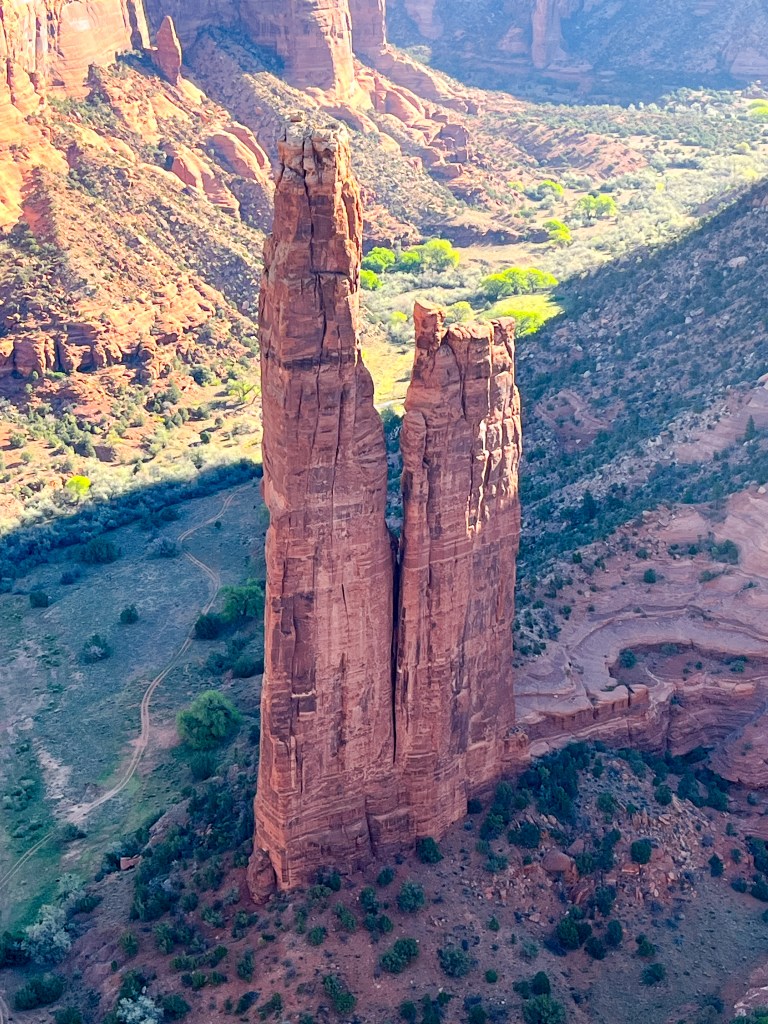
Below us rises a slender, 800-foot sandstone spire, the Spider Rock. The Navajo believe that the Spider Woman (Na’ashjéii Asdzáá) wove the universe and descended into the canyon to teach the Navajo women how to make yarn from sheep wool, dye it, and weave it.
This rock is her home and her workshop. A Spider Woman cross is often woven into Navajo rugs as a way to honor her teachings.
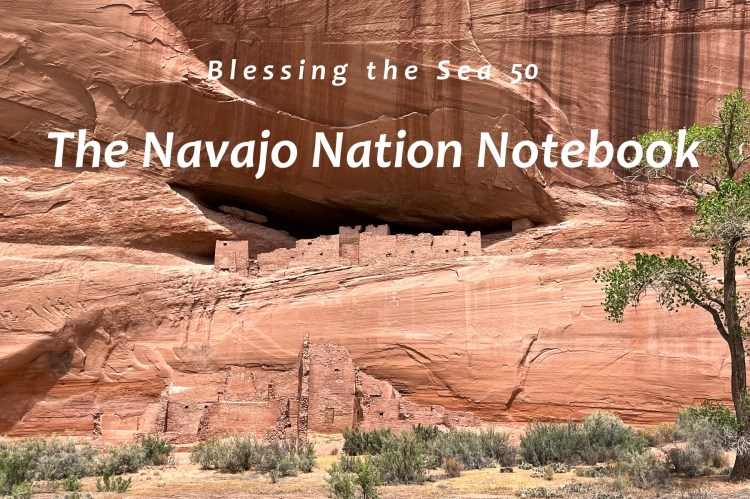
Several clusters of ancient Anasazi (ancient Puebloan) ruins are secreted into the opposite wall of the canyon, near the canyon floor. Our Jeep tour takes us past these sites, ending at the so-called White House Ruin – a spectacular 70-room Anasazi (Ancestral Puebloan) cliff dwelling from 11th-13th centuries (see top).
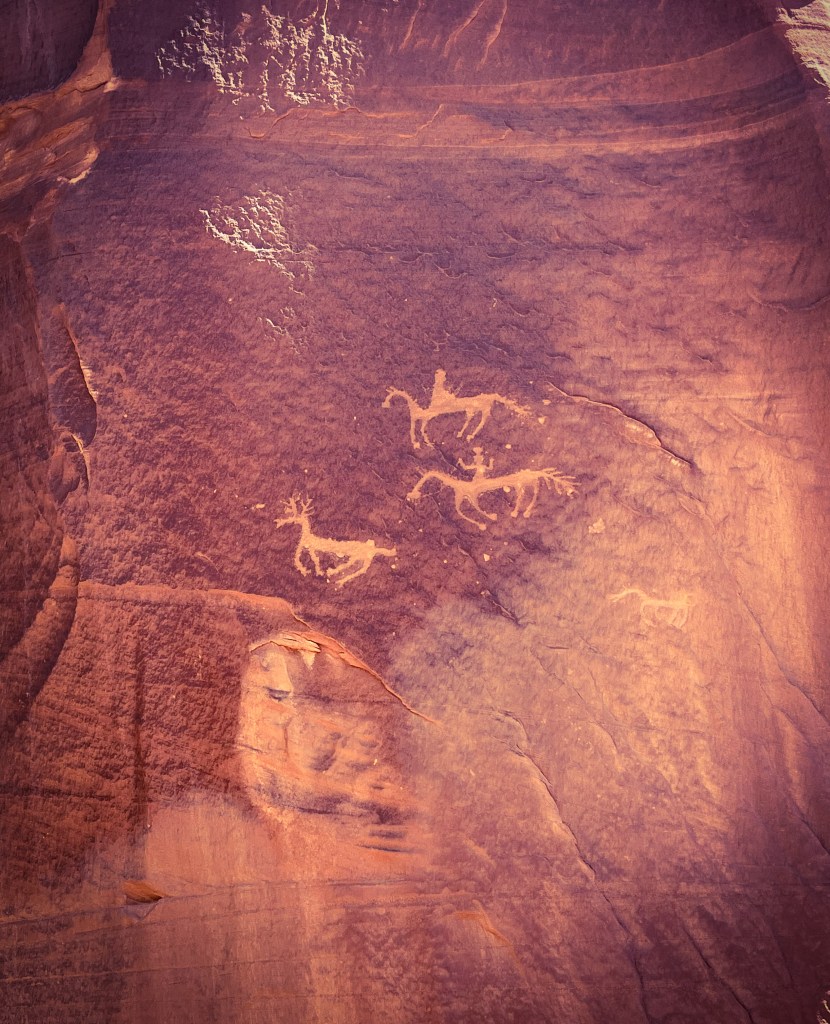
A few wild horses are grazing by the side of the road, as well as sheep which belong to Navajo families who live in the canyon. Horses also pop up in the petroglyphs cut into the canyon wall.
It’s a bumpy fun type of ride, and we do get stuck once in the sandy arroyo which provides the track. I enjoy hearing the five Jeep drivers chat in Diné Bizaad (Navajo) along the way.
Archeologists believe that the region hit its population peak around 1100 CE. Yet a century later, most sites, including the White House, were deserted for no apparent reason. Scientists attribute it to fluctuations in rainfall and competition for agricultural land.
Hopis, who have descended from the Anasazi and to whom the canyon remains sacred, explain it differently. In their communal memory, leaving a comfortable, settled site is a way for people to cleanse themselves of an unethical way of living.
“If surviving myths and legends are listened to with care, they may tell us that these restless ancestors were also searching for places of spiritual harmony with nature. For throughout [these] myth-legends are references to flights from imperfection and evil, and to long journeys in fulfillment of moral prophecy.” — Harold Courlander, The Fourth World of the Hopis
Succumbing to immoral violence or failing to honor kachina spirits taint a community and, in turn, affect the environment, reducing the rainfall, necessitating a new migration. In other words, nature changes because of human behavior, not the other way around.
This Hopi belief reminds me of the second paragraph of the Shema, an excerpt from Deuteronomy [Devarim] 11, which we recite daily:
“If you obey the commandments that I enjoin upon you this day, loving the Eternal your G-d and serving with all your heart and soul, I will grant the rain for your land in season, the early rain and the late. . . [Otherwise,] G-d’s anger will flare up against you, shutting up the skies so that there will be no rain and the ground will not yield its produce; and you will soon perish from the good land that G-d is giving you.”
The similarity is striking.
We return to the canyon around 9 pm to watch the constellations reveal themselves in the night sky above our heads. In Navajo lore, each star in the sky has a story. “The medicine folk say that [stars] sing their stories to each other. Once you know their stories, they’ll sing to you as well” (Brian Young, Healer of the Water Monster).
I do not hear their music, only the rustle of the wind across the mesas. The canyon itself is pitch black, save for a couple of dim lights sparking from Navajo homes in its crevices below. It’s a reminder that the canyon is not a museum, but a home.
II. South. This is our planning direction where we plan what we are going to do. It’s the direction of the Day.
A drop of water and a fossil print comes alive. We are southwest of our tour base in Tuba City, AZ, walking the ‘Bird Tracks’ (Tsídii nabítiin) of the Moenave Formation – dozens of tracks left by roaming, running dinosaurs and other Jurassic-era creatures on the exposed bedrock, some as big as a human head.
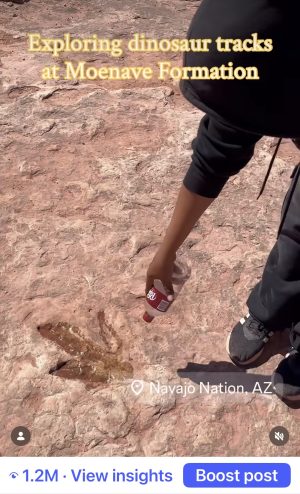
We wouldn’t have noticed them without a young guide who pours water from a plastic bottle over dark impressions in the stone.
My short video of the Moenavi dinosaur track goes viral, passing 2 million views and generating 1,700 comments. I am not sure why it happened, but I’m glad it’s getting the word out about an astounding, off-road site.
Hopi, the older residents of the area, believe that these are the footprints of Kwaatoko, the Monster Eagle, a man-bird who comes to rescue people in times of need.
We explore the tracks for an hour, but I stray from the group further out on the plateau. The view is so wide that you can see the rain coming down hard in one corner of the horizon while the sun is beating down elsewhere.
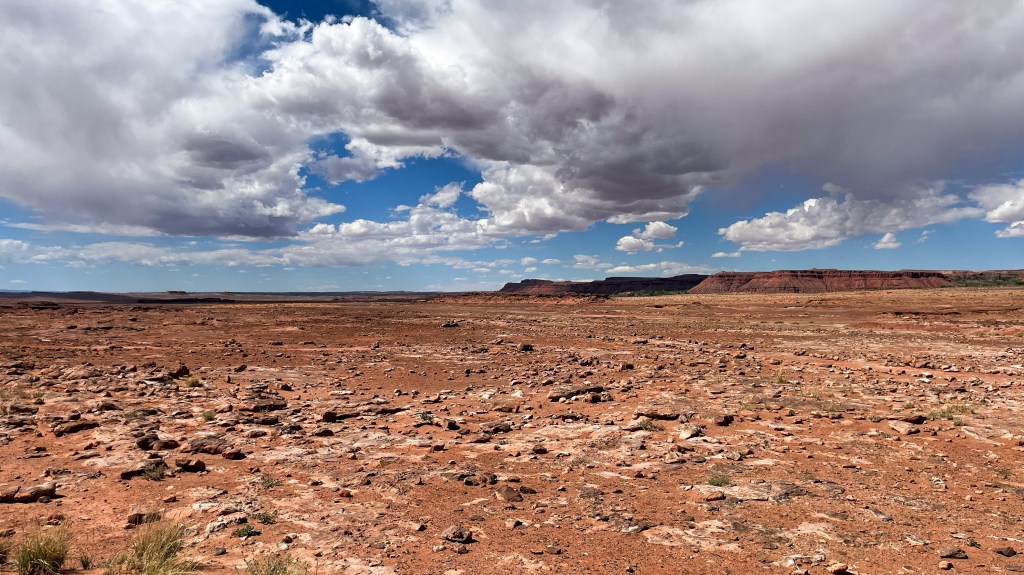
“That’s male rain: a strong, but quick downpour,” comments our guide Milton Tso. “The female rain is light and steady.”
Hearing him embody rain with human qualities reminds me how interconnected he is with his native land. I felt similar in my January sojourn to northern Israel where forests, creeks, and brooks hold ancient memories. You do not pass through, you become part of the land, and the land – part of you.
III. West. This is our life, and is where we do our living. It corresponds to Yellow Evening Twilight. Here is where we act out our plan and our thoughts of the east and south directions of our lives.
An alpine country stretches across northwestern Arizona from Seligman to Flagstaff and the San Francisco Peak. This peak, or “Dook’o’oosłííd,” The Summit that Never Melts, symbolizes the western direction in Navajo cosmology, the western frontier of their worldview.
This high country is home to ponderosa pine forests. “Fire has always been the primary architect of [these] forests,” wrote the eco-writer Peter Friederici. Ponderosas need low-level fires to clear out underbrush fuels — branches, twigs, pine cones and dead vegetation — to maximize their sun and water exposure and reduce their risk from diseases and insects.
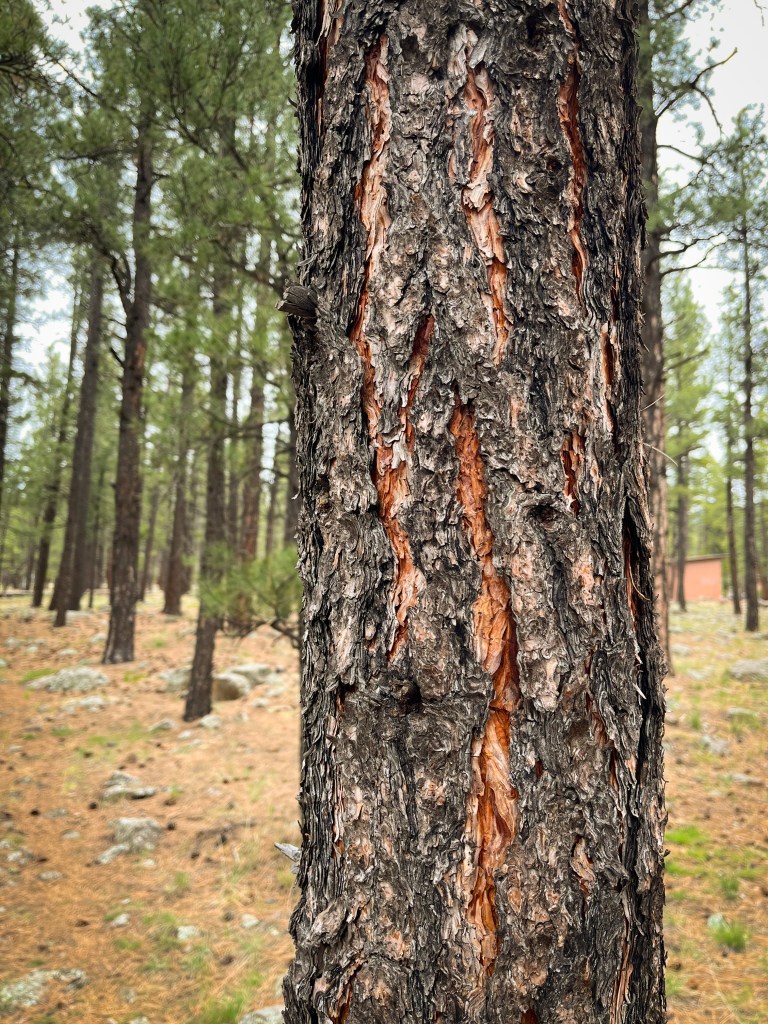
How do these pines survive a fire? They start out with black bark, but as it ages, the bark thickens, turning cork-like and flaky, the color lightenin to golden yellow. If you see a ponderosa with golden bark, it has to be at least 150 years old.
During a fire, the tree drops its burning bark to the ground to prevent heat penetration into the living tissue.
This also couples with the tree’s another interesting feature – self-pruning – the ongoing dropping of dried out lower branches. This is how this elegant, slender tree can survive for up to 600 years.
How can I make it through my fires to an old age with grace and vitality? What branches should I drop to move more nimbly through life stages?
IV. North. This is the evaluation portion of our lives. North is Night because this is where we evaluate the outcome of what we first started in the east. Here is where we determine to change things to make it better, or to see if we are on the right path and should continue the cycle.
The Monument Valley (Tsé Bii’ Ndzisgaii) in the northern part of the Navajo reservation is more traditional. You see more hogans, the traditional polygonal Navajo huts, used for both religious purposes and as living quarters.
Here hogans are covered in packed earth, as opposed to exposed wood, resembling even more closely Mongolian yurts – not a coincidence. Archeology and DNA studies suggest that the Navajo migrated to America via the land bridge out of southern and eastern Siberia, which borders Mongolia, not reaching the Puebloan lands until the 16th century.
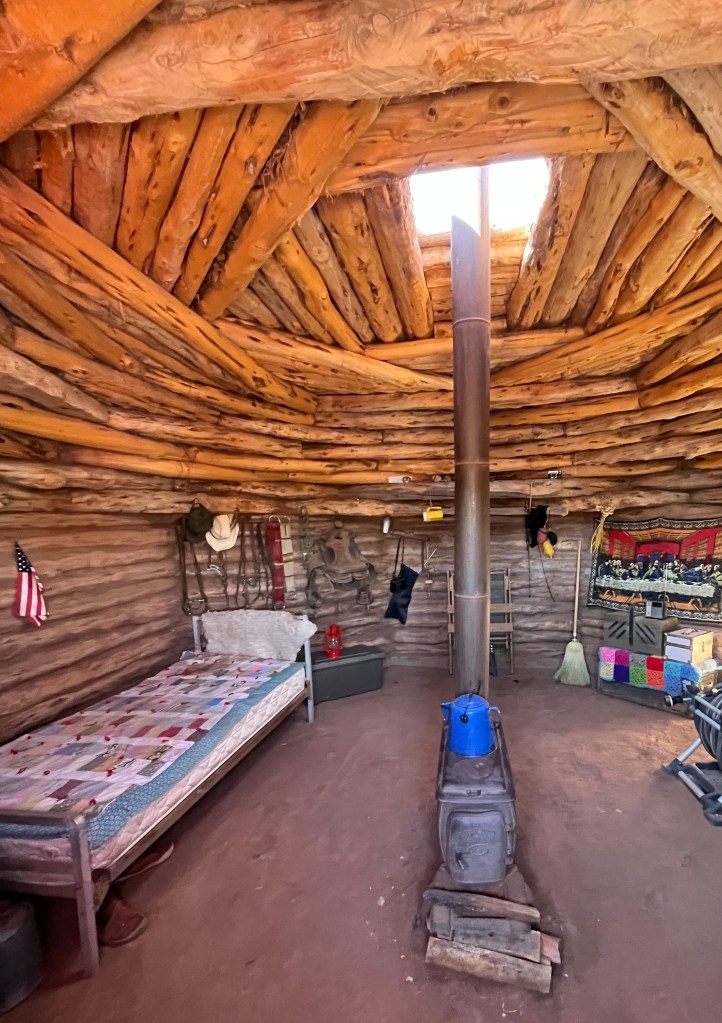
“Some homes here do not have running water,” points out our guide Milton, “especially older people. Trucks bring water for them and their animals. It’s part of life here.”
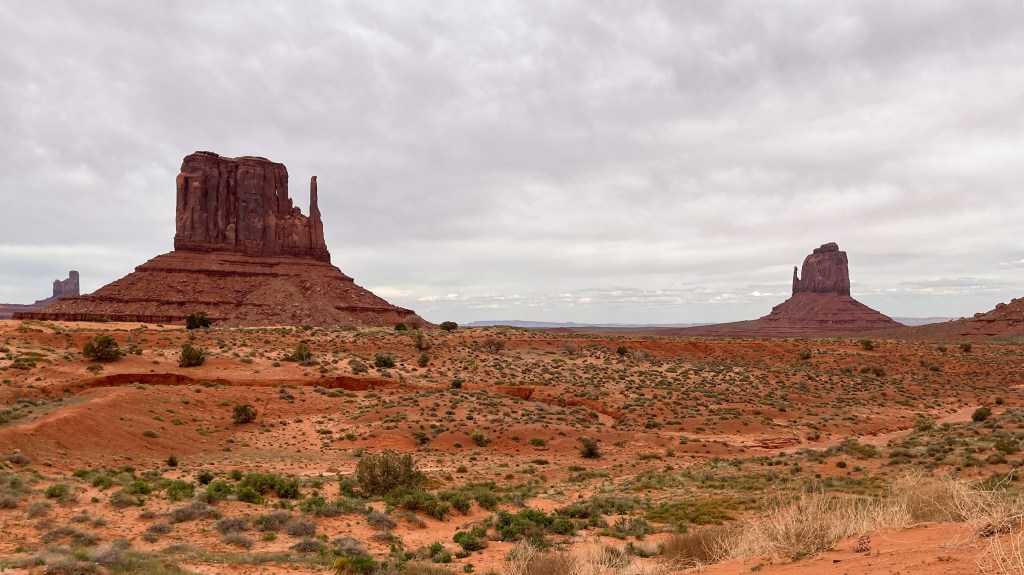
The valley is impressive. Rocks sculpted by water and wind, jut up and tower over the ground festooned with chapparal and wild flowers, but it’s mostly sand, miles and miles of sand.
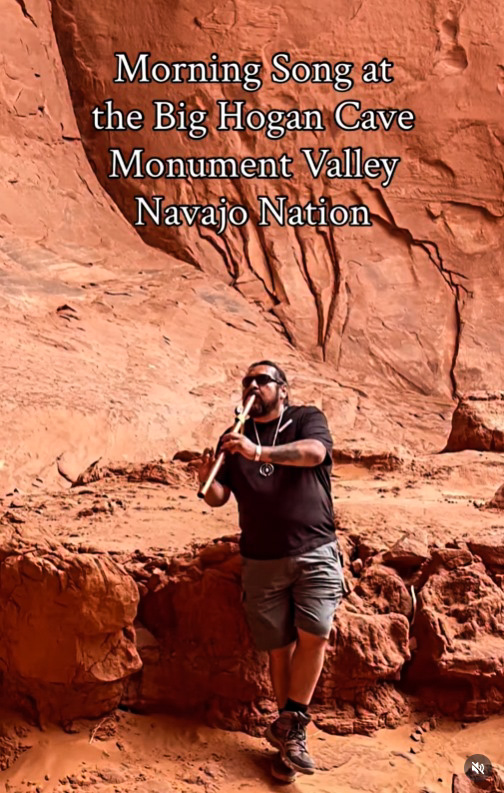
We get into a second Jeep caravan which takes us on a 17-mile drive around the buttes and mesas of the Monument Valley Navajo Tribal park. Everything is massive – the views, the rocks, the sand dunes.
At one of the sites, the Big Hogan Arch, Milton pulls a flute out of his backpack and plays the “Morning Song.” The stone walls of this giant cave with an opening at the top provide perfect acoustics.
The music gathers all of us in a sheltering cave. A timeless experience.
Thank you for sharing this journey with me.
–Lane
* In his classic The Fourth World of the Hopis (UNM Press), the folklore historian Harold Courlander systematized the Hopi oral tradition. I can’t recommend it enough.
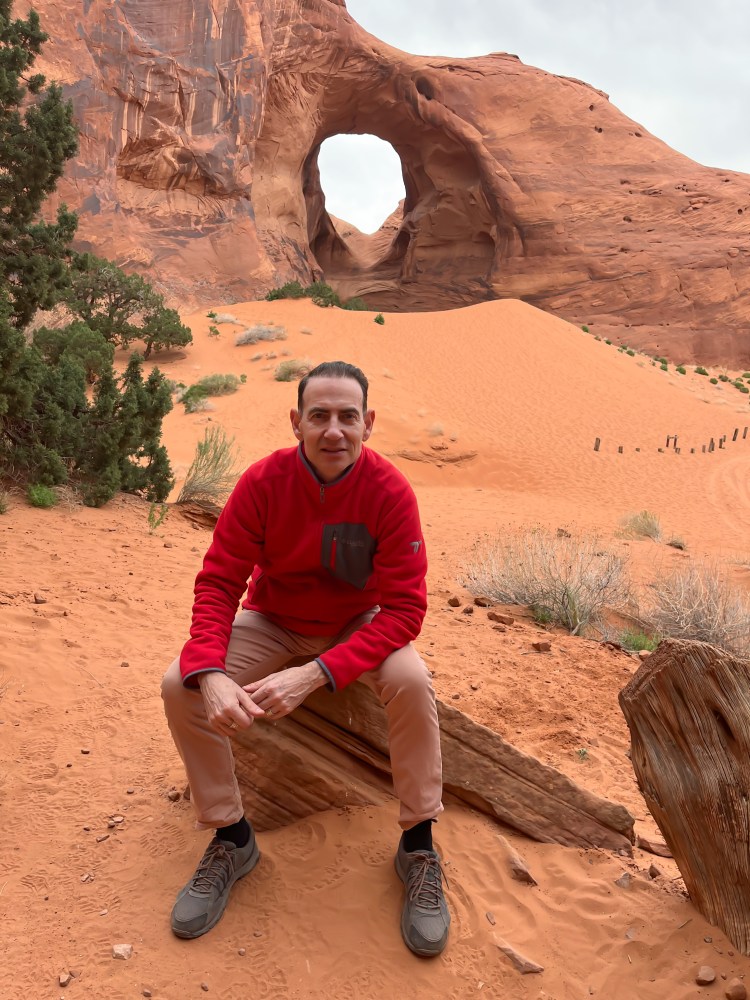
All photos are © Lane Igoudin, 2026
Related BTS issues
#47 A Galilean Notebook, Part 2
#46 A Galilean Notebook, Part 1
#42 A Rocky Mountains Notebook

