My newsletter is named after a traditional Jewish blessing upon encountering the majesty of a large body of water: “Blessed are you, our eternal G-d, Ruler of the Universe, who made the great sea.” BTS is a free, monthly publication which shares Jewish and non-Jewish approaches to mindful, contemplative living. Some come from from spiritual teachings from the past and the present; others from my Zen practice and Jewish faith. Included here are also some of my own news as well. BTS is a conversation, and I enjoy hearing from and responding to the readers.
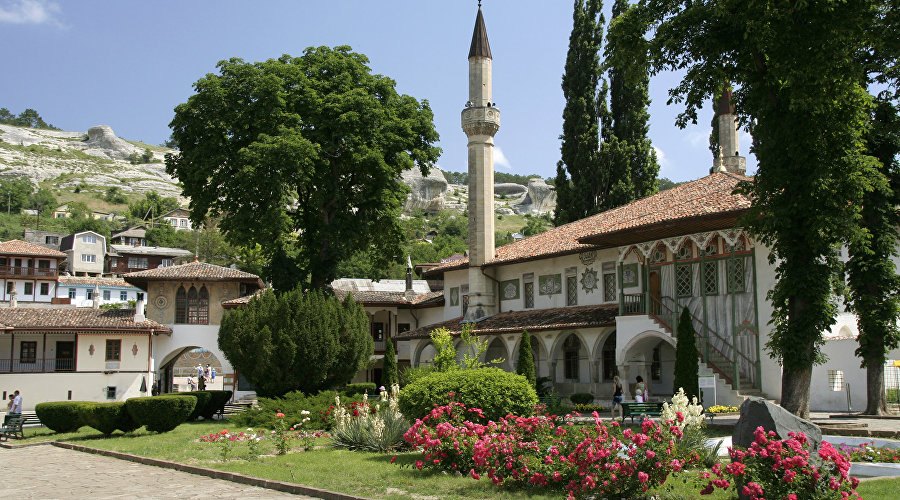
“Denounced to the authorities, Pinye-Ber befriends a Russian official who saves him from deportation. The friendship between the peyes-and-kapote shochet and “that righteous gentile who rescued me” extends to the official’s family taking Pinye-Ber’s daughter Nekhamele to tour Khansaray, the Tatar rulers’ opulent 16th-century residence. The image of a Russian couple chaperoning a Jewish girl through the Tatar palace’s halls, mosque, harem, and gardens is a telling metaphor of what Crimea once was . . .”
— From my review of “The Shochet” in Tablet
Dear Friends:
Two of my articles came out earlier this month in Jewish Journal and Tablet, linked by a common thread – overlooked stories from the Jewish past with lessons for today. One is about the rise to prominence and a spectacular fall of a once flourishing Jewish kingdom in Southern Arabia. The other is about a kosher slaughterer thriving in the multicultural Crimea during the tsarist era. I am delighted to share them with you below.
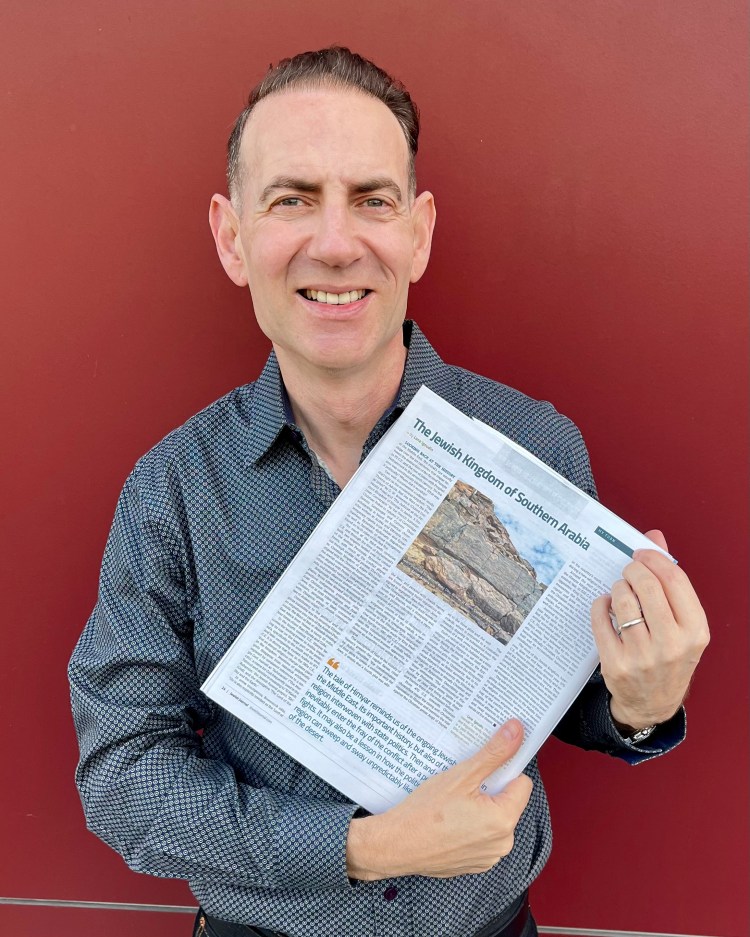
The Jewish Kingdom of Southern Arabia
Jewish Journal, April 17-23, 2026, p. 24
The tale of Himyar reminds us of the ongoing Jewish presence in the Middle East, its important history, but also of the danger of religion interwoven with state politics.
Looking back at the history of the Middle East, the mind’s eye usually skips over the six centuries that elapse between the destruction of the Second Temple in 70 C.E. and the rise of Islam with Prophet Mohammed in the seventh century. Yet the area was continuously inhabited. What was it politically? Whom did it worship?
Two well-documented academic works shed light on the mysterious kingdom: The Throne of Adulis: Red Sea Wars on the Eve of Islam by G. W. Bowersock (Oxford University Press) and “The Judaism of the Ancient Kingdom of Himyar In Arabia: A Discreet Conversion” by the French historian Christian Robin in volume 3 of Cambridge Semitic Languages and Cultures.
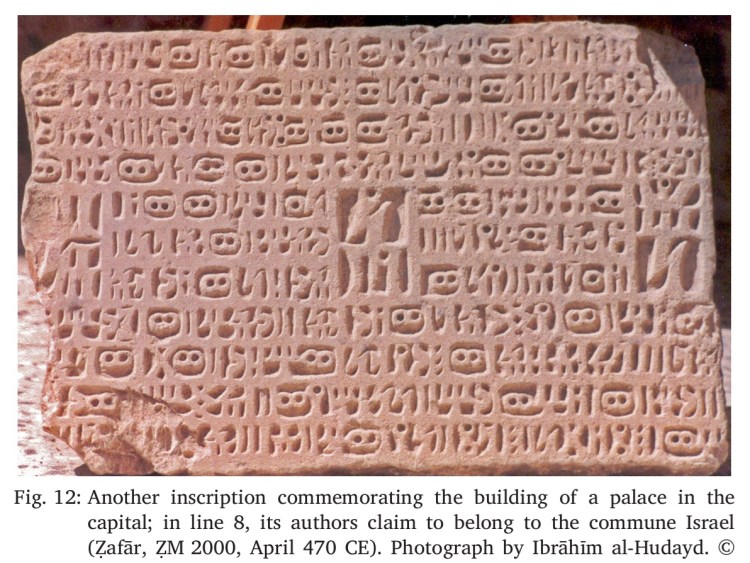
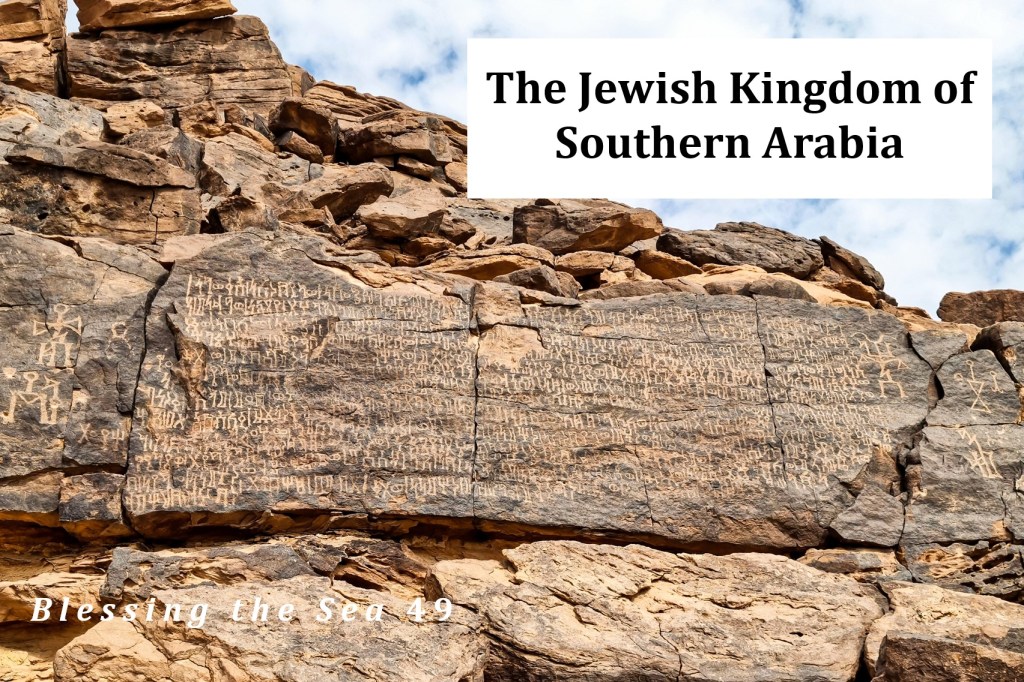
Their scholarship is based on historical chronicles written in Arabia and Ethiopia, contemporary reports from Indian and Syrian travelers, Byzantine diplomatic dispatches, as well as hundreds of stone inscriptions found on both sides of the Red Sea.
For much of the 3rd-6th centuries C.E. and through the time of Mohammed’s birth, two empires battled over the control of the Arabian Peninsula: Byzantium and Persia, with much of the conflict played out through smaller local proxies. The Coptic Christian kingdom of Axum (Ethiopia) aligned with the Christian Byzantium, while the Jewish communities throughout the region aligned with Persia. Independent Arab tribes controlled various parts of the peninsula, and their alliances shifted constantly.
Religiously, before Islam, G. W. Bowersock explains, those tribes divided into those that practiced indigenous, polytheistic cults, Arab Christian denominations, and Arab Jews, that is Arab tribes that converted to Judaism, alongside, or likely connected with, diasporic ethnic Jewish communities of Judean origin.
Contributing to the political and religious instability was the recurring Ethiopian migration into parts of the Arabian Peninsula: the Strait of Bab el-Mandeb dividing East Africa from Yemen is barely 18 miles, four times closer than Florida and Cuba.
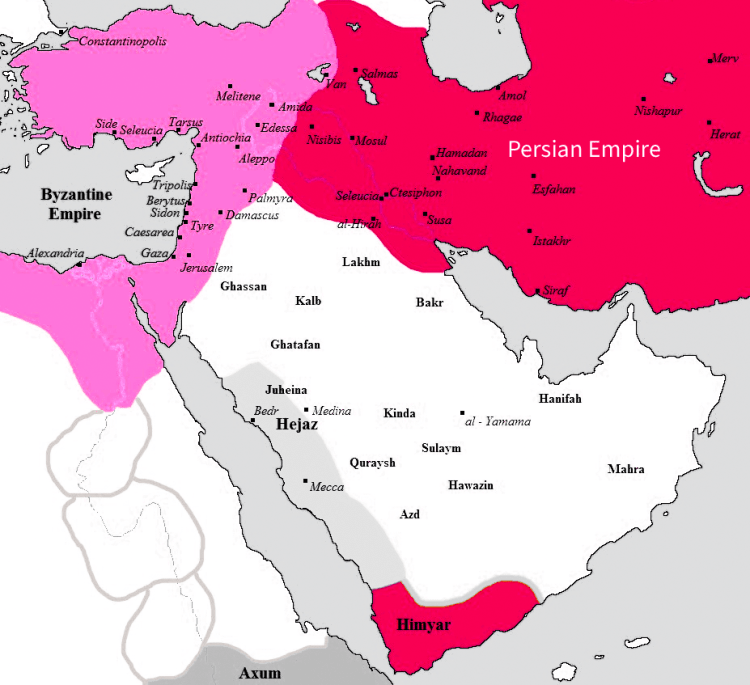
In the 4th century C.E., Himyar becomes the leading power in Arabia, imposing its rule on the large part of the peninsula, specifically in the south and the west, and later conquering eastern Arabia in 474 C.E. It is during that time, in the 380s C.E., that an abrupt religious change takes place in the kingdom.
Mentions of polytheistic gods disappear from historical evidence, replaced by consistent references to a single G-d, named as “Rahmanān” (“The Merciful,” a name for G-d frequently used in the Talmud and similar in meaning to “El Maleh Rahamim,” the Jewish funeral prayer), “Eln” (God), and the descriptive “The Lord of the Sky and the Earth.”
In some inscriptions, Bowersock adds, “He is also explicitly invoked as the ‘Lord of the Jews’, and persons with Jewish names are found imposing burial regulations designed to segregate Jews from non-Jews. . . The Himyarites took over such words as Amen and Shalom, and a Himyarite seal, now in a private collection, bears a representation of a menorah.”
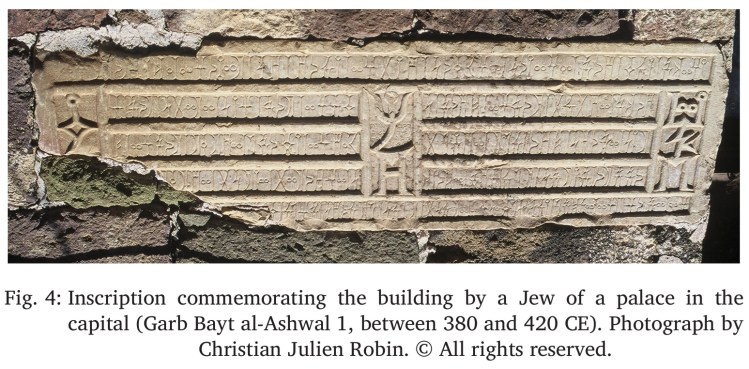
Christian Robin counts at least 10 Himyarite inscriptions referring to the mikrāb, a new word denoting a synagogue, which also survives in the Ethiopian Ge’ez language. One such inscription made by King Madikarib Yun’im (c. 480–485 C.E.) commemorates the construction of a mikrāb while also using the word knesset, apparently, to denote an assembly room within the synagogue.
The inscription of Hasi in the vicinity of Yemen’s present-day capital Sanaa, cited by Robin, describes “the transformation of four plots to create a cemetery only for Jews. It details that a fourth plot was added to the three plots and the well . . . The mikrāb, which is entrusted to a custodian (hazzān), drawing its subsistence from the revenues of a well, owns landed estates.” . . . CONTINUE TO READ ONLINE →︎
What first caught my eye in The Shochet is its setting: Crimea!
Three types of Jewish communities – Ashkenazi, Karaite, and Krymchak – once lived there among the Muslim Tatar majority and the sizeable Greek and Slavic minorities. Growing up in Russia, I visited Crimea with my family and still retain a distinct sense of this place.
I am simply thrilled with Tablet‘s publication of my review shared below.
The Shochet by Pinye-Ber Goldenshteyn
An ordinary Jew’s extraordinary account of survival in the Pale
Tablet, April 6, 2026
Shochet, the kosher slaughterer, was once a central figure in the shtetl. Most shtetlach dotting the Pale of Settlement of the Russian Empire were too small or too poor to support a rabbi, so slaughtering aside, the shoykhet, in Yiddish terms, would be a communal jack-of-all-trades—a khazn leading services on Shobes and yontef, a moyel for the boys as well as their melamed in Hebrew and Torah, and often the community’s shadkhan arranging suitable marriages.
The shochet’s very appearance in a full beard, peyes, and a kapote was the embodiment of the tradition. Yet despite his communal importance, the shochet’s was not an easy life.
“Better be a manual laborer than to have one of these spiritual occupations,” Pinye-Ber Goldenshteyn (see right) laments as he recounts his life story in his memoir The Shochet.
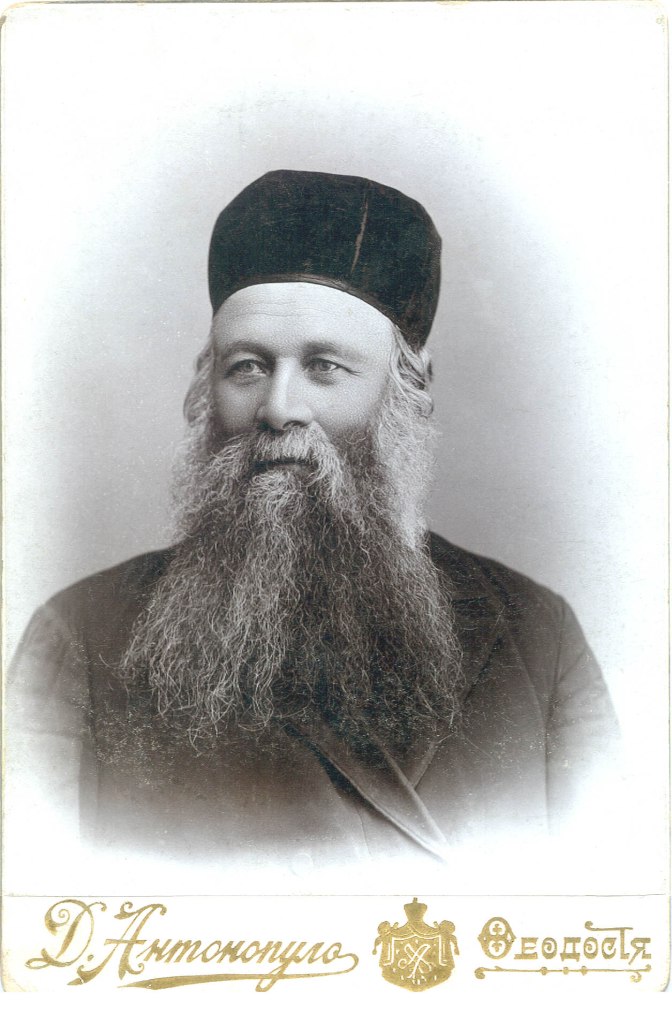
Originally published privately in Petah Tikva, Israel, in 1929 in Yiddish and now translated for the first time in its entirety into English, Goldenshteyn’s 800-page book is one of the first surviving Yiddish-language autobiographies.
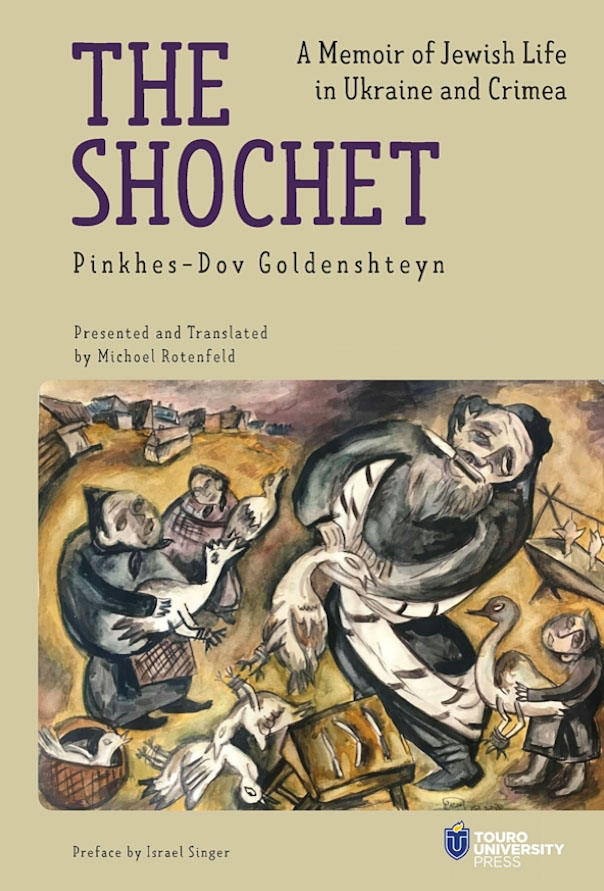
It is also unique in being penned not by a famous and secularized Jew, the two categories usually going together, but by someone from the masses of the poor and traditional Jews who populated the Pale.
In his memoir, Pinye-Ber, as the author was commonly known, takes us chronologically from his childhood and young adulthood in Bessarabia and Ukraine, to his 34 years as a shochet in Crimea, to his retirement in Palestine.
Born in 1848 in Tiraspol in Bessarabia (present-day Moldova) to “poor parents surrounded by naked, barefoot siblings, large and small,” Pinye-Ber, the youngest, loses both parents by age 6. His adult sisters are too poor to support him, and so the relatives keep searching for a family to take in the little boy—a childless couple in their hometown; grandparents in Groseles; an elderly aunt in Chechelnyk (incidentally, my grandparents’ birthplace); as an apprentice to an uncle; as a shtib-meshures, a house servant, to a well-off cousin in another shtetl; “moving from one uncle to the next, from one aunt to the next, until they packed me off and sent me back.”
Pinye-Ber’s wanderings grow more far-flung as he progresses into his teenage years, covering thousands of miles from Yassy in Romania to Lubavitch in Belarus and then south to Odessa and the Crimean Peninsula.
What’s striking is that despite its vast geographic spread, the Jewish world of the 1850s-1870s Pale is uniform enough in its customs and language that a frum boy like Pinye-Ber can walk into an unfamiliar shtetl, pray mincha and maariv in the local beis-medresh, crash there for the night, and in the morning, shake up the minyan for a few kopeks to travel on.
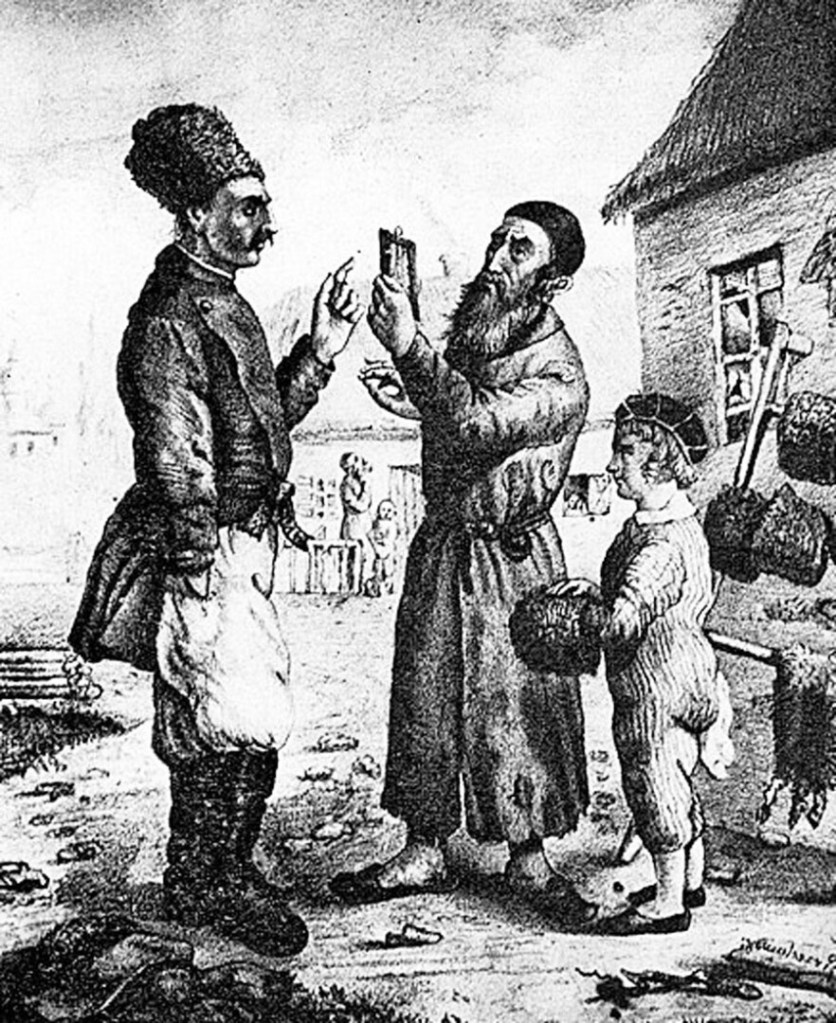
In Pinye-Ber’s account, Jews and non-Jews live peacefully side by side, each serving a specific function within the Russian Empire. Jews are artisans and traders. Non-Jews are farmers, most of whom, especially in Ukraine, are serfs indentured to their estates. The Tsarist regime is oppressive, yet its iron hand instills a pacifying sense of order.
(Left: Jewish shopkeeper and Ukrainian customer (19th cent. engraving).
The main danger to the young Jew at that time, particularly to a poor orphan like Pinye-Ber, is the abiding fear of being caught by the khapers (grabbers) and conscripted into the Russian army for 25 years. The kidnapping, as Pinye-Ber witnesses, can happen in broad daylight or at the Shabbat service.
“And suddenly . . . a commotion broke out in the shul; a mortal fright overcame the entire congregation. As everyone pushed to look out the windows, they saw entire regiments of soldiers surrounding the synagogues – standing guard to prevent the children from escaping. The khapers entered, seized the boys, and handed them over to the soldiers. Mothers dashed about like poisoned wolves and their cries reached the seventh heaven.”
Pinye-Ber escapes the khapers’ clutches thanks to his sister, who smuggles him under her dress out of the synagogue and into a neighbor’s attic.
A more secure way to avoid the draft, Pinye-Ber discovers, is through marriage, though not just any marriage. CONTINUE TO READ ONLINE →︎
Thank you for reading my articles, and please do not hesitate to reach out. I love hearing from you!
–Lane