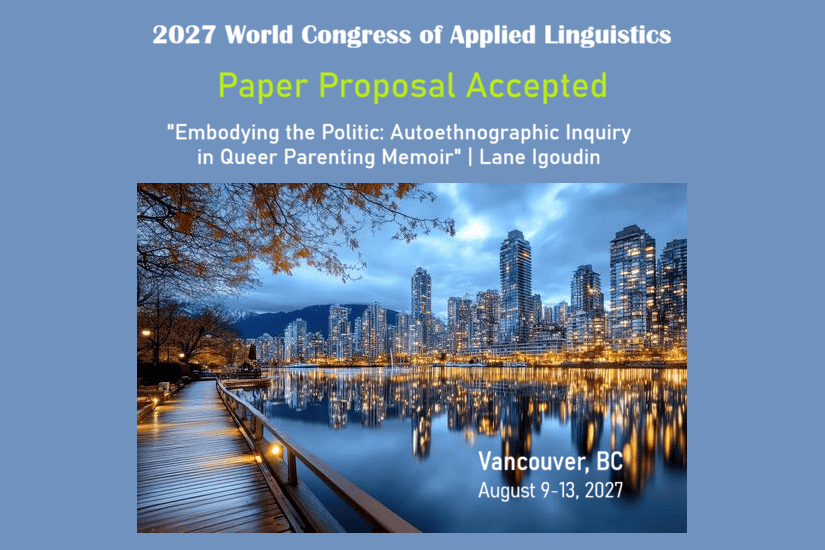
“Embodying the Politic: Autoethnographic and Dialogic Inquiry in Queer Parenting Memoir”
22nd World Congress of Applied Linguistics (AILA 2027)
Vancouver, BC, Canada | August 9-13, 2027
Paper Presentation #431
Strand E32 Applied Linguistics Methods and Methodologies / Narrative Analysis
Abstract
The present study applies the critical autoethnographic approach to the presenter’s LGBTQ parenting memoir A Family, Maybe to elucidate multiple meaning perspectives affecting the writer’s memoiristic narrative as well as dialogical relationships between the narrator and himself as subject, witness, and activist, and between his personal experience and social context.
Proposal
Interweaving personal testimony and social observation, a memoir can provide space for autoethnographic and storytelling inquiries. While writing his gay parenting memoir A Family Maybe (Ooligan Press, Portland State U., 2024; Ophel Press, 2026), the researcher acted out multiple roles as a narrator, subject, witness, social critic, activist, and ethnographer. His book documented the formation of a new family type in the U.S. in the early 2000s – an out LGBTQ family – and the LGBTQ community’s struggle for equal rights during that time, with which the narrator’s family formation narrative was intertwined. His memoir also exposed related social issues such as systemic dysfunctions in the US child welfare and juvenile dependency court systems.
The present study, which appeared in Gabor, Georgina O. (ed.), Writing as Performance, Cambridge Scholars, 2024, analyzes the presenter’s memoir from a secondary, autoethnographic standpoint (Ellis & Bochner 2000, Goode, Lumsden, & Bradford (eds.) 2023, Lapadat 2017). In doing so, it elucidates multiple meaning perspectives (liberal, queer, social reformist, and so on) affecting his memoiristic narrative. This approach also exposes critical dialogical relationships (Blommaert 2015, The Cambridge Introduction to Bakhtin 2021) forming between the narrator and the subject, as well as between the narrated personal experience and its social context.

