Course content and delivery at my college, as in all higher education institutions in California, remains exclusively monolingual, while serving the student population that is often majority Latinx and bilingual.
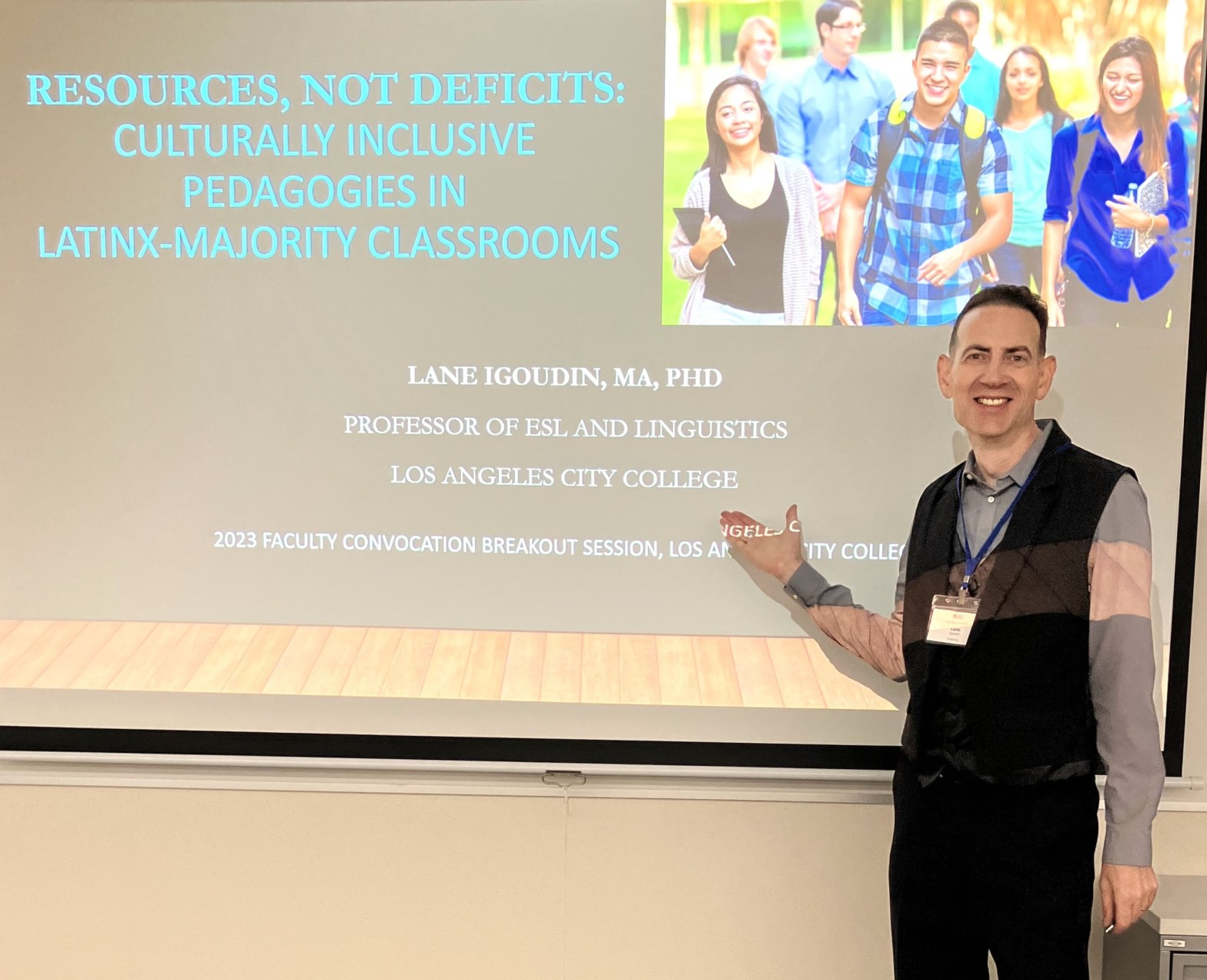
On Aug. 24, as part of the annual LACC Convocation (faculty training) Day, I gave a talk on the pedagogies in English composition courses that are inclusive and innovative. My presentation, “Resources, Not Deficits” was based on the study I’d published this year and presented earlier this summer at the World Congress of Applied Linguistics, but here I refocused it on specific, practical ways to make our classrooms more inclusive for Latinx students.
First, I provided some background both on our Latinx student population and culturally responsive teaching (CRT), which emerged in the last two decades. (Fact: 54% of LACC students are Latinx.)
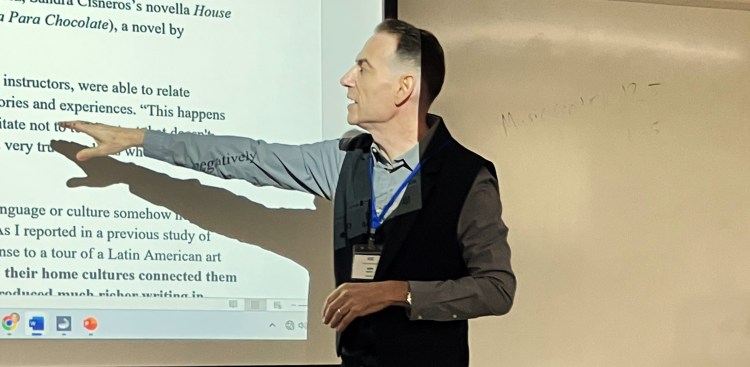
I then organized the culturally inclusive teaching methods observed in the English composition courses on my campus into 3 groups – those that address curriculum, engage student culture, and introduce linguistic diversity (e.g., Spanish, Spanglish, Chicanx English, and/or Indigenous languages) in our English classrooms. Each group of methods was supported by real-life examples from our faculty.
Following that, my presentation shifted to the skills that a culturally responsive faculty member should possess (as derived from a recent survey of CRT methods across the US (Muniz, 2019)). Here, we tried out an activity applying these approaches to the attendees’ own experience and courses. Judging by the questions from the audience and the overall feedback I received, these critical pedagogies generated a lot of interest among faculty. Clearly, it’s an important topic that needs to be explored continuously and in more depth.
Please contact me directly with questions about the presentation or related matters. I’ll be glad to tell you more about it.
 Lane Igoudin | Author, Professor, Dad